
Application of LaNi₅ storage beds for vehicular applications
Type of project: SPRINT
Partners
This SPRINT was led by the University of Bristol in collaboration with an industry partner:
Hydrogen Future Industries – SME partner providing industrial insight, commercial context, and strategic direction for vehicle integration and future deployment pathways
The collaboration builds on a three-year working relationship in hydrogen technologies and was significantly strengthened through this focused proof-of-concept study, laying the foundations for further joint proposals and scale-up activity.
Impacts at a glance
Demonstrated proof of concept for metal hydride hydrogen storage in vehicles: By designing and testing LaNi₅ storage beds under realistic operating conditions, the project showed that hydride systems can operate within pressure ranges required for fuel cell vehicles, offering a lower-pressure alternative to compressed gas tanks.
Enabled vehicle-integration feasibility studies using a real-world platform: Through assessment of compatibility with the Toyota Mirai, the project explored safety, centre-of-gravity, space constraints, refuelling dynamics, and control system integration.
Advanced experimental capability through new reactor and imaging approaches: Collaboration with the ISIS Neutron and Muon Source and Diamond Light Source enabled real-time observation of hydrogen absorption, generating high-value data for upcoming publications and future proposals
Strengthened regional hydrogen innovation capacity: The project acted as a catalyst for further bids, deepened industry-academic ties, and reinforced the South West’s growing clean transport cluster.
Short project description
Hydrogen-powered vehicles such as the Toyota Mirai currently rely on high-pressure gas tanks, which are costly to manufacture, energy-intensive to fill, and present storage and safety challenges. This SPRINT explored whether metal hydrides, specifically the metal hydride alloy LaNi₅, could provide a safer, lower-pressure and potentially more compact alternative for onboard hydrogen storage.
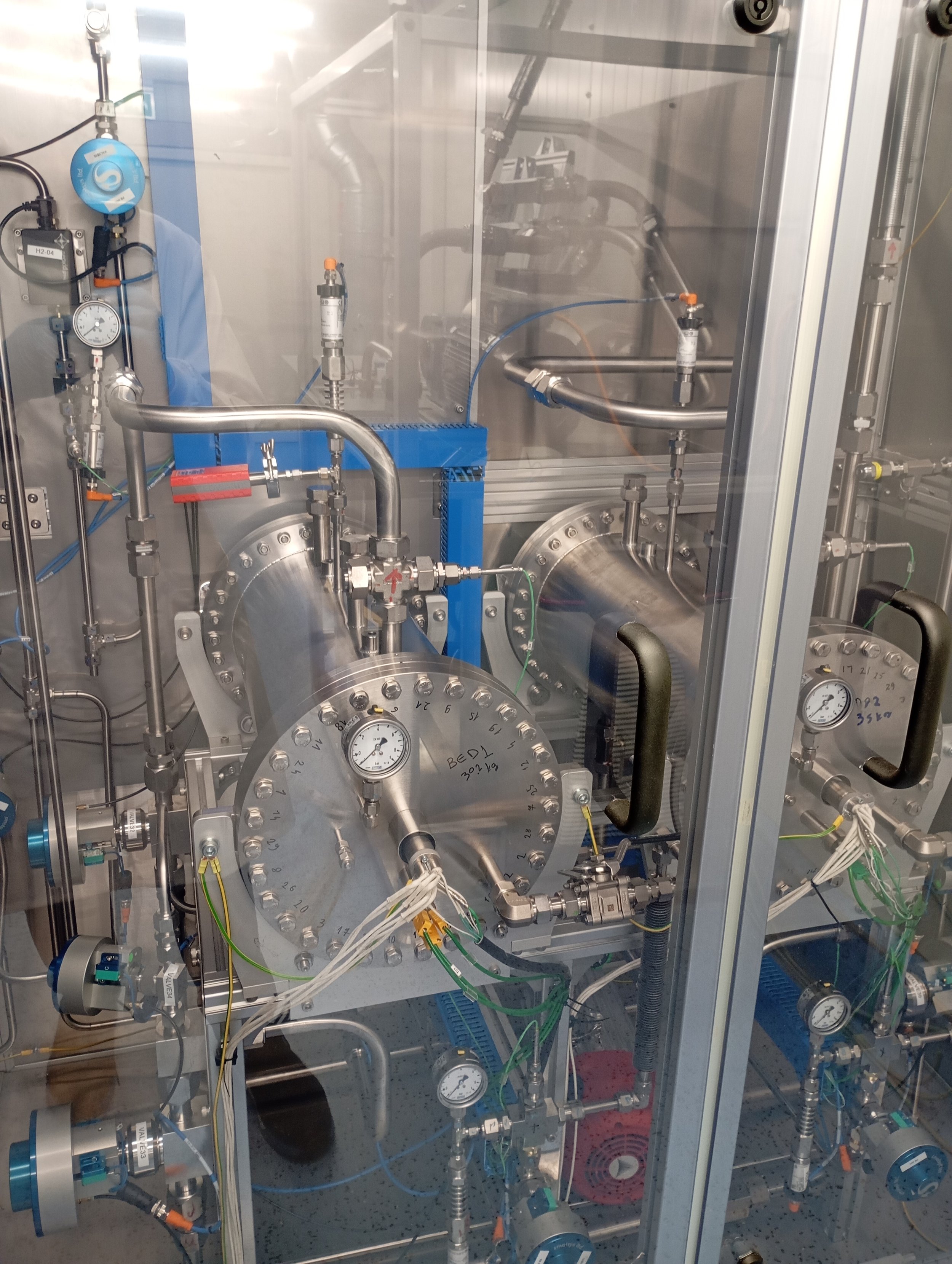
Building on earlier hydride research, the team developed a specialised reactor capable of testing metal hydrides under tightly controlled temperatures and pressures representative of vehicle operation. A prototype storage bed, incorporating enhanced internal heat transfer structures and advanced manufactured components, was designed and evaluated.
The project also assessed the feasibility of integrating a LaNi₅ system into a Toyota Mirai platform, examining spatial constraints, safety requirements, compatibility with existing fuel cell systems, vibration resilience, and centre-of-gravity considerations. Experimental results demonstrated stable material distribution, effective heat management, and operation within relevant pressure windows; important steps toward real-world deployment.
By taking a focused concept study through to practical testing, the project helped move hydride research from laboratory materials science toward applied vehicle innovation, providing evidence needed to explore commercialisation and full-scale demonstrator pathways.
Academic Quotes

Dr Antonis Banos, Research Fellow, University of Bristol
“Through this project, we were able to explore options beyond conventional high-pressure storage and test whether metal hydrides could realistically be transferred into vehicle applications. The proof-of-concept work has given us greater confidence in the technical feasibility and highlighted where further innovation is needed, particularly around reducing system weight.

Dr Jacek Wasik, Research Fellow, University of Bristol
“Agile funding like this opens doors. It brings partners together, acts as a bonding glue between academia and industry, and allows us to solve immediate technical challenges while building momentum toward larger-scale commercial projects and full facility ambitions.

Professor Tom Scott, Professor in Materials, University of Bristol
“Taking hydride storage from controlled laboratory studies into a vehicle-relevant context has been a significant step. This work not only strengthens hydrogen innovation in the South West and across the UK, but also contributes to the wider global transition toward low-carbon mobility.”