For early-stage businesses working in hydrogen, having a strong technology or business idea is only part of the challenge. Finding the right partners, building relationships across a relatively small but rapidly developing sector, and turning conversations into opportunities can be just as important.
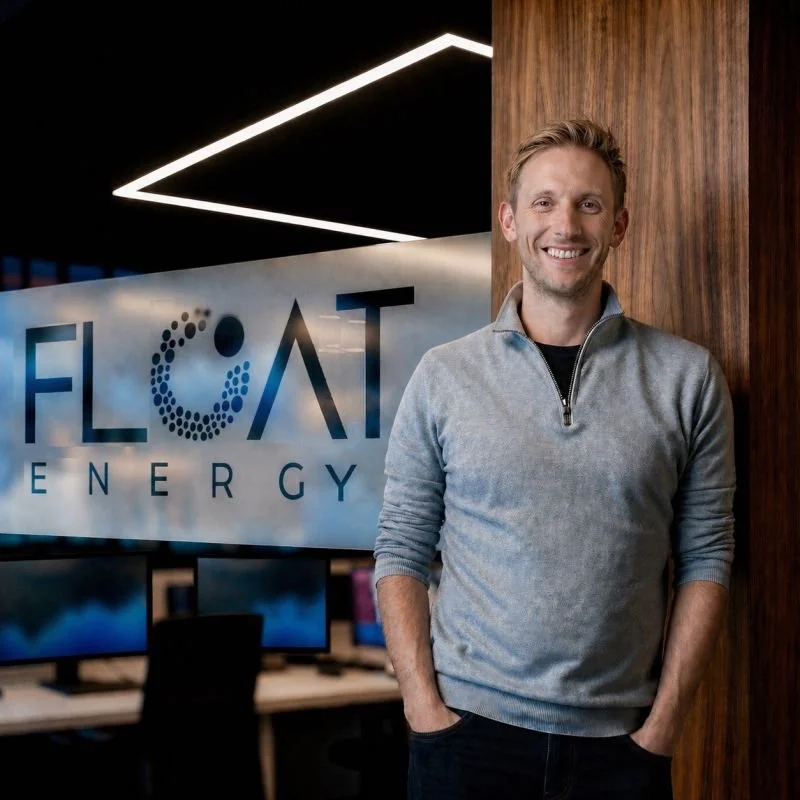
For Adam Meekings, Founder of FLOAT Energy, the Hydrogen Ecosystem Builder, provided an opportunity to do exactly that. Looking to expand his network and find partners who could help commercialise his technology, Adam joined the programme with a clear objective: get out of the business, get talking to people and start building the relationships needed to move the company forward.
Since taking part, FLOAT Energy has secured a pre-seed investment round, established a partnership to demonstrate its software in a real hydrogen plant, and is progressing from Technology Readiness Level (TRL) 3 towards TRL 6 and beyond.
We spoke to Adam about his experience of the programme, what he learned about building partnerships, and why one of the most valuable things an early-stage business can do is simply talk to as many people as possible.
What made you decide to join the Hydrogen Ecosystem Builder programme, and what were you hoping to get from it?
“I joined because I was passionate about the sector. I was looking to collaborate more, increase my connections and take my business to the next step. You never quite know what you’re going to get on these things, but it seemed like a well-thought-out programme with the potential to solve one of my biggest problems.
What were you working on before you joined, and what were the main challenges you were looking to address?
“I think my main challenge was that I needed a partner, particularly a hydrogen plant.
“The hydrogen sector is growing, but because it’s still a relatively close-knit industry, building the right connections is important. There might be this golden person that you need out there, and it’s not always possible to just send them an email. They’re not always in your black book.
“It’s impossible to do things without partners, and getting those partnerships seems like a dark art. You don’t quite know how it happens. I was keen to get out there, build my network and start opening up conversations with potential partners who could help us commercialise the technology.”
What did you find most valuable about the experience?
“I think the key thing I took away from it was learning to leverage your partners’ connections and, in turn, their partners’ connections. You might only know one person, but they might know another 10. Before long, you could have 100 people to speak with. However, you need to offer value to open up those connections.
“You end up with this view that there might be a person or organisation who isn’t directly related to what you want to do, but they might know someone who is. It might not be what you originally expected.
“You might be looking for a plant and instead end up with an investor, or you might be looking for something else and end up with some patent advice.
“I think generally being open-minded about partnerships is important. At a very early-stage business, things are kind of all over the place, but one of the best KPIs you can have is just to talk to as many people as possible and see how you can help them. This is the best way to find product-market fit, but it’s also what a healthy industrial ecosystem needs.”
Did the programme change the way you think about partnerships, or who you need to work with?
“It made me think about what value I can offer. You start your business by offering value to your customers, but you need more than customers to build a business. You also need investors, employees, suppliers and advisors, and they all perceive value differently.
“As a start-up, you haven’t got a super-sparkly proposition. So, you’ve got to work out what that proposition is for lots of different types of people. Not everyone will respond to your customer pitch, and lots of people will lose interest after the first 10 words. It’s important to capture their imagination quickly.
“At first, it feels like you’re speaking to lots of people and getting nowhere. It’s best not to think of this as a linear thing. A partnership comes out of lots of work, building credibility and developing a reputation. If you’re genuinely trying to help people and the industry, then your name will start to travel. When someone first approached me at a conference and knew who I was, I couldn’t believe it, but somehow my message and FLOAT’s value were spreading”.
How did you find the format of the programme?
“I thought the self-paced learning was great. It had real-life examples and videos, and it felt really specific to hydrogen.
“They had real hydrogen companies talking about what worked for them, and it felt closely aligned with what FLOAT were doing.”
What was it like working alongside other people from the hydrogen sector?
“Definitely useful because it is a small industry, and I think it’s really tough. So, to have some peer support there is good. I think it brings everyone a bit closer because we’ve all got the same frustrations, and we’re all, to some extent, trying to solve the bigger problem of decarbonisation.
“Being in a peer group also brings out why you’re actually doing this. I’m doing this because I really think hydrogen has a huge scalable impact on decarbonisation, and when you talk to people on these sorts of programmes, you see their big dreams and you feel so energised.
“When you’re in a group, and you’re talking about quite open-ended things, you realise why you’re in the industry in the first place, how you might be able to help others and how they can help you. You empower each other to carry on.”
“Sometimes day-to-day conversations can be highly commercial about price or ROI. However, these environments can be quite transactional. It’s great when you can open up the possibilities of what a partnership can accomplish.
Was there a particular session or exercise that changed the way you were thinking?
“There was an exercise around your partner proposition - what you want from people and what you can offer them - that changed my thinking about what I could offer different types of partners.”
How useful was it to hear from experts and other organisations working across the hydrogen sector?
“It did give me a different perspective. My background was working for a big company, and they had a particular way of doing things. Start-ups and early-stage ideas have to start a lot smaller and be more flexible in how they do things.
“Seeing how people are still able to make progress with a minimal product and minimal investment, while still making viable and impactful progress and being safe, was quite cool to see.”
Towards the end of the programme, you presented your opportunity to an expert panel. How did you find that experience?
“That experience was really good. They gave me some people to speak to and helped open up conversations with people in their networks. It was a good example of the course practising what it preached - speaking to people, finding out who they know and using those networks to make connections.
“There was our cohort, but you then had the panel, and the panel had their own network. So, it showed that they could put you in touch with the people you need, even if the person on the panel themselves might not have been an immediately obvious person to work with.”
Looking back now, has anything changed as a result of taking part?
“Since I was on the programme, I’ve been able to go to some other incubators and, with my new “partnership mindset”, feel like I’m making a bit more progress each time. We have secured some investment, so we’ve closed a pre-seed round. We’ve got a partner to help prove our software in a real hydrogen plant, and we’re progressing from TRL 3 towards TRL 6 and hopefully beyond quite quickly.
“Overall, being part of the GW-SHIFT programme was the first step in getting in the room with other collaborators, rather than thinking about your idea too much, writing too many theoretical business plans, or trying to work everything out in isolation. It was the first step in just getting out there.”
What would you say to someone working in hydrogen who is considering joining the programme?
“You’ve really got nothing to lose, and the potential benefits of partnerships are massive. The course facilitators were great. They generally had an answer for everything. They could identify your problems, talk about them quickly, link in other people’s problems, prompt the conversation and get it going quite well.
“The facilitators who led the course were great. And the support after that has been tangible. They’ve put me in touch with people. We’ve talked about applying for grants and working together.
“Not every opportunity is the right opportunity, but with GW-Shift you become part of their network, whereas sometimes you sign up for these things and it’s no more than a webinar, and then you never hear from them again. I would say if people were thinking about doing it, you’ve got nothing to lose. Whatever you put into it, you’ll get out of it.”
Ready to build your hydrogen network?
If you’re developing a hydrogen project, looking for strategic partners, or exploring how your organisation can play a role in the growing hydrogen economy, the Hydrogen Ecosystem Builder programme can help you take the next step.
The fully funded programme combines self-paced learning, live expert sessions, real-world hydrogen case studies and opportunities to connect with organisations across the hydrogen ecosystem. You’ll develop your proposition, identify potential partners and finish by presenting your opportunity to an expert panel for feedback and connections.
Applications are open for the next cohort. You can apply at any time and, once accepted, get immediate access to the online training materials before joining the next available series of live sessions.
Find out more and apply for the Hydrogen Ecosystem Builder programme