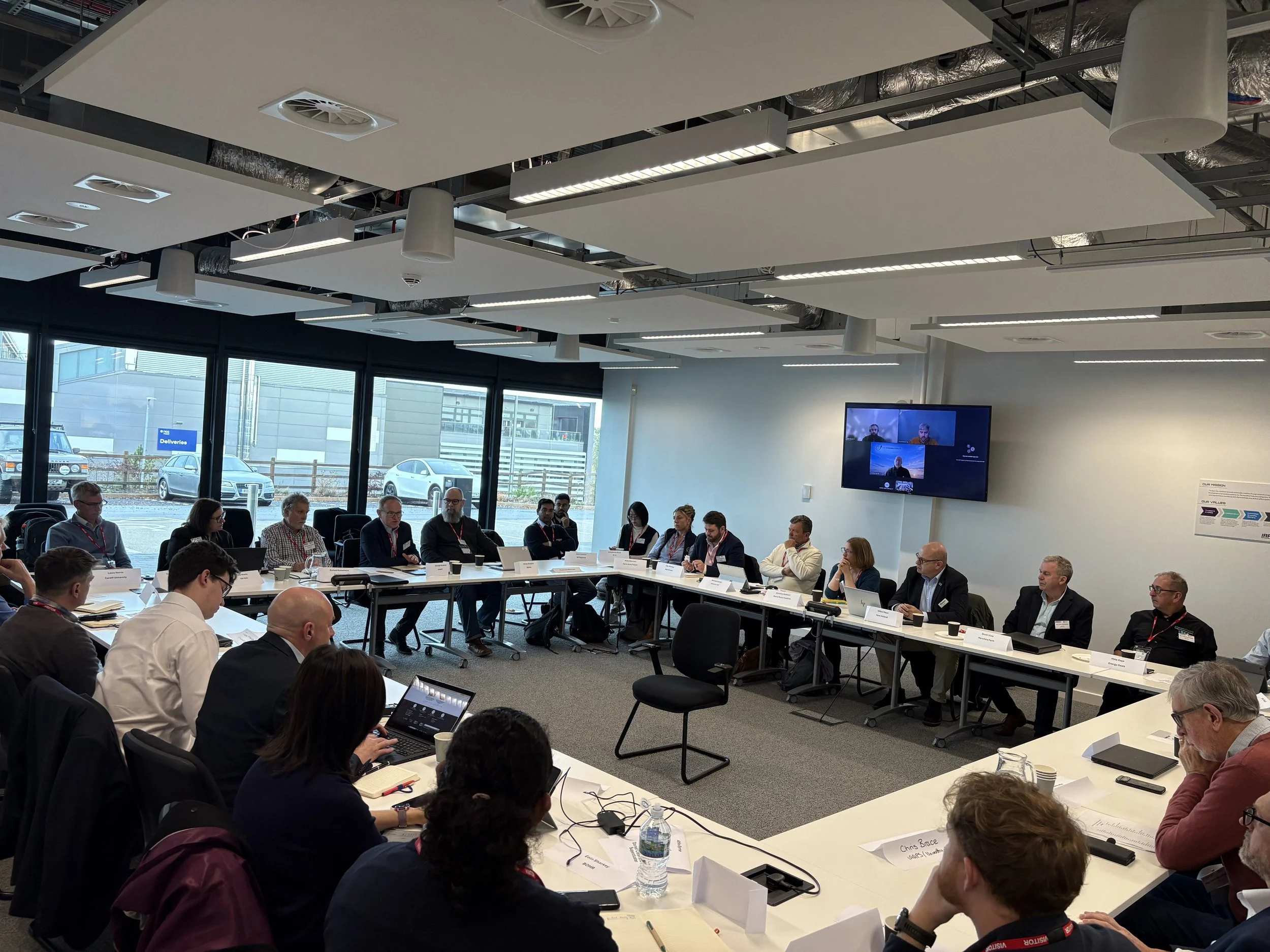
Representatives from agriculture, industry, research and policy gathered at the Futures Innovation Hub to explore how low-carbon gas fuels could help farms and rural businesses reduce their reliance on fossil fuels.
Hosted by IAAPS in partnership with GW-SHIFT and Farm of the Future, the roundtable brought together farmers, technology providers, academics, on-farm energy experts and representatives from the Department for Environment, Food & Rural Affairs (DEFRA), the Department for Energy Security and Net Zero (DESNZ) and the Department for Transport (DfT) to discuss how low-carbon gas fuels could offer alternatives to diesel in agricultural machinery and rural industry.
Chris Brace, Associate Pro Vice-Chancellor (Innovation - IAAPS) at the University of Bath, welcomed everyone to IAAPS, championing the closer collaboration between industry, research and policy to accelerate sustainable propulsion and alternative fuels. He reaffirmed the university’s commitment to innovation as a distinct part of its work, focused on addressing real-world challenges and working with external partners to develop practical solutions.
George Eustice, Managing Director of Penbroath Ltd and former Secretary of State at the Department for the Environment, Food and Rural Affairs, chaired the roundtable, highlighting the importance of moving beyond decarbonisation ambitions to identify practical solutions for rural businesses: “We need practical routes to Net Zero that people can adopt. That means keeping a mix of technologies in play, avoiding premature choices that close off future options, and making use of existing infrastructure where possible.”
Delegates discussed biomethane and hydrogen-powered engines as alternatives to diesel for demanding applications, alongside the potential of locally produced fuels. Chris Foxall, Founder and CEO at Hyppo, underlined hydrogen’s wider role in connecting local energy resources: “Hydrogen isn’t a competitor to electrification. It can be produced from different sources, stored, and used across power, heating and other applications, while also supporting products such as fertiliser. Farms are well placed to connect local energy and natural resources, strengthening energy security and giving farmers greater certainty over costs.”
Farm of the Future brought an important agricultural perspective to the discussion. Through its work with the Royal Agricultural Society of England (RASE) and Innovation for Agriculture, the initiative explores how farms can reduce their environmental impact while maintaining food production and business viability.
Richard Gueterbock, Director of Foodchains at Farm of the Future, set out how low-carbon gas fuels could support agriculture and unlock new opportunities for the sector: “On-farm production of low-carbon gases such as biomethane is an opportunity to turn resources like manures, slurry and other farm residues into a valuable source of fuel. Capturing and using gas fuels on farms will help reduce reliance on fossil fuels, while creating opportunities for farms to supply clean energy locally. To realise that potential, we need practical support for on-farm gas fuel production, alongside the infrastructure and collaboration needed to make these fuels and gas-powered vehicles more widely available.”
Turning these opportunities into practical solutions for farms will require overcoming barriers around production costs, storage, distribution and refuelling infrastructure. Stuart Cole, Director at Cole Farming, highlighted the need for simpler regulation and targeted support: “For farmers to invest, the rules and support need to work at farm scale. At the moment, the numbers are difficult to justify.” Mike Kaye, Founder and Director at Energy Oasis, added to this sentiment, identifying the need for adoption, rather than technological development: “The technologies are already mature and working; the challenge is getting them adopted and putting them to use on farms. The focus should be on practical deployment, not treating established solutions as if they still need to be invented.”
The potential for the South West of England and Wales to become a demonstration region is evident, bringing together its agricultural sector, renewable energy resources and engineering expertise to develop practical projects. Karen Brooks, Deputy Director at GW-SHIFT, outlined the importance of bringing together different perspectives across the region to explore low-carbon gas fuels, and develop key policy recommendations: “Bringing together perspectives from across the region helps us understand the opportunities and practical barriers around low-carbon gas fuels. By working across farming, industry, research and policy, we can identify shared priorities and develop recommendations that support real-world adoption.”
The roundtable closed with a call to build on the discussion through continued collaboration. Participants highlighted the value of connecting the ecosystem with government policy to address practical barriers and support the wider uptake of low-carbon fuels. This included bringing together machinery manufacturers, fuel suppliers and farmers to develop on-farm demonstrations, alongside seeking dedicated funding to support the transition.
GW-SHIFT convenes partners across South Wales and the South West to support the development of a thriving low-carbon hydrogen economy capable of delivering clean growth, industrial resilience and energy security for the UK.
Listen to Episode 9 of The Only Way is Hydrogen? Can the Farms of Tomorrow Feed Us...and Power Us?
GW-SHIFT’s Deputy Director, Karen Brooks, spoke to Richard Gueterbock in episode 9 of The Only Way is Hydrogen? Can the Farms of Tomorrow Feed Us...and Power Us? Karen and Richard delved into the potential for farms to become integrated energy hubs, exploring how renewable electricity, biomethane and hydrogen could contribute to the future of rural energy. One such farm already making this a reality is Menchine Farm, where Stuart Cole, Director at Cole Farming, uses the renewable energy he produces to support local industrial heating.
Listen to Episode 9 of The Only Way is Hydrogen to learn more about how green hydrogen, and other low-carbon gas fuels can support the rural economy across the UK.