
Hydrogen Week: The role of hydrogen in transport
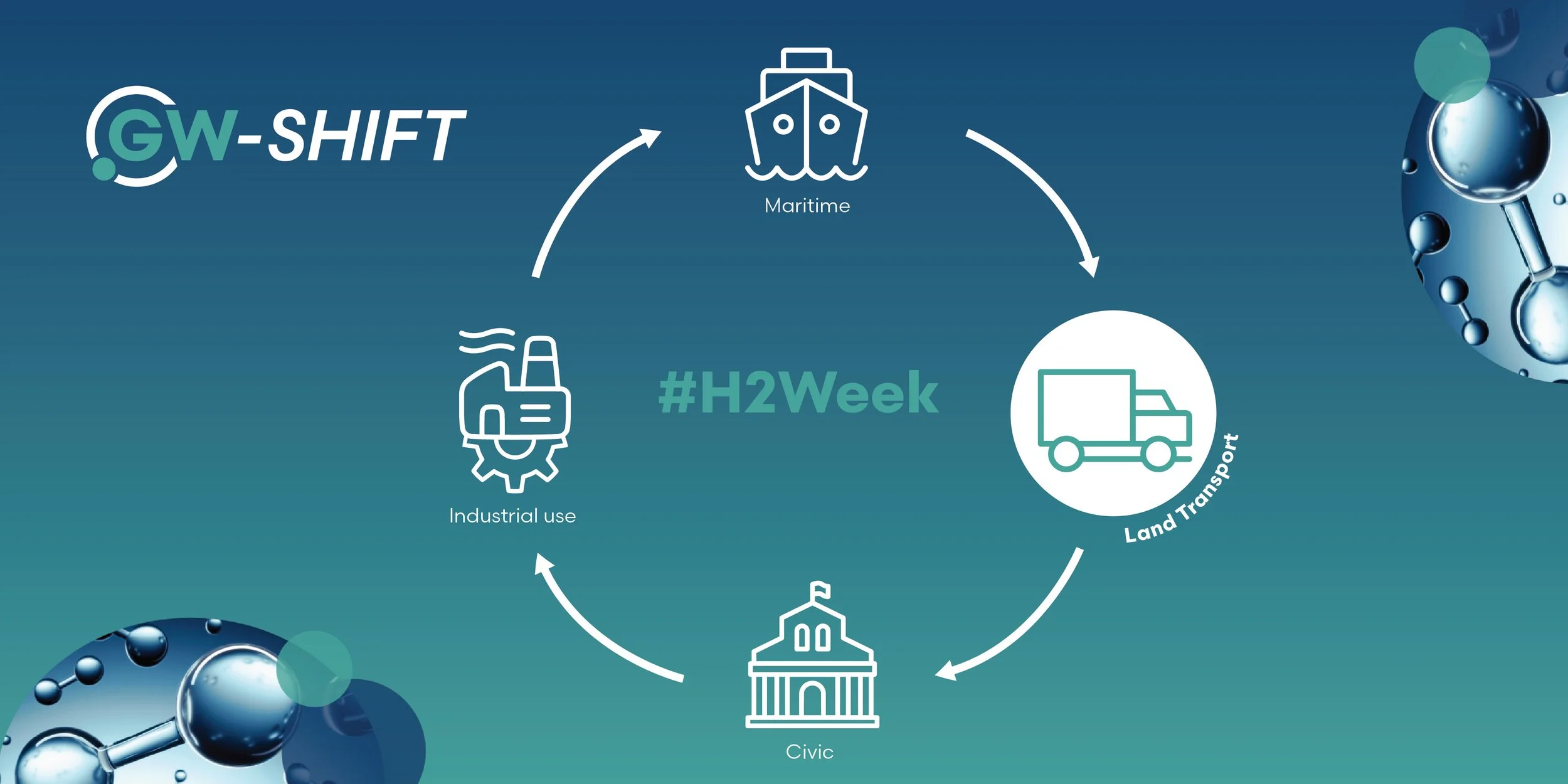
Across Hydrogen Week, we’ll be looking at role of hydrogen in decarbonising different sectors. Today we turn our attention to transport. In this piece, we look across the board from hydrogen buses on Welsh routes and fuel cell trials in community fleets, to heavy freight corridors and airport ground operations proving what's already possible.
Transport decarbonisation is often framed as a straight switch to electric. For cars and short journeys, that infrastructure largely holds. But once you move into heavier vehicles, longer routes, and continuous-duty operations, the challenge changes.
Buses, HGVs, construction fleets, airport ground services, and even parts of rail don’t just need low-carbon energy; they need energy that can be refuelled quickly, used intensively, and deployed in places where grid upgrades or charging infrastructure aren’t always practical.
That’s where hydrogen is beginning to carve out a clear role: not replacing electrification, but complementing it where batteries and infrastructure struggle to meet operational demands.
Hydrogen mobility is already being tested in real settings
Across Wales and the South West, hydrogen transport is moving beyond theory into live demonstrations and early deployments.
One of the clearest examples comes from Hyppo Hydrogen Solutions, working with Marubeni Europower, which has already delivered hydrogen fuel cell car journeys for Bridgend Community Transport. While small in scale, these kinds of trials are important: they test not just vehicle performance, but how hydrogen integrates into real community transport services.
Protium Green Solutions is also building a broader hydrogen mobility ecosystem. Its work spans green fleet trials, construction applications, and off-grid energy solutions, reflecting a key advantage of hydrogen: it can serve both transport and stationary power needs from the same production base.
Through its HyHaul Mobility platform, Protium is also targeting one of the hardest sectors to decarbonise: heavy freight. Based in Cardiff, the initiative is developing plans for hydrogen refuelling infrastructure in the Avonmouth industrial area, supporting HGVs along the M4 corridor. This kind of corridor-based approach is increasing in popularity for scaling hydrogen logistics.
Public transport, aviation, and specialist fleets are already involved
Hydrogen is increasingly appearing across a range of transport applications, from scheduled bus services through to aviation and specialist operational fleets.
The Wales National Transport Delivery Plan includes four hydrogen bus projects: Swansea Bay, Pembrokeshire, TrawsCymru T5 (Haverfordwest - Aberystwyth), and TrawsCymru T6 (Swansea - Brecon), with deployment targeted by 2026. These routes are particularly valuable test cases as they operate at a consistent high frequency, making them a strong application for real-world fleet decarbonisation.
In aviation, hydrogen is beginning to move beyond ground operations into propulsion development. At ZeroAvia, hydrogen-electric powertrain technology is being developed and tested for use in zero-emission aircraft, with a focus on short to medium-haul flights. This represents a significant advancement in aviation decarbonisation, extending hydrogen’s role from airport operations into the aircraft themselves.
With hydrogen already being demonstrated in airport logistics at Exeter Airport, their UK-first live turnaround trial used hydrogen-powered ground support equipment, including a baggage tug, pushback tug, and ground power unit. The demonstration showed how hydrogen can reduce emissions in tightly scheduled airport operations without affecting turnaround efficiency.
In South Wales, local trials have also helped build an operational reputation. Neath Port Talbot Council tested hydrogen buses on routes across Swansea and Neath Port Talbot in 2023, providing practical insight into performance, refuelling logistics, and passenger experience in everyday service conditions
The Welsh Government has also begun scoping their National Transport Delivery plan across Wales for hydrogen rail lines, including the Heart of Wales and Cambrian services.
Building the infrastructure behind hydrogen transport
Unlike electrification, hydrogen transport relies heavily on upstream and midstream infrastructure; production, storage, compression, and distribution all need to scale together.
Hydrogen can be transported in several ways depending on the use case, with each method coming with trade-offs in cost, efficiency, and safety requirements:
● compressed gas in cylinders or tube trailers for flexible distribution
● cryogenic liquid tankers for higher-density transport
● pipeline networks for large-scale, continuous supply
For example, MorGen Energy have constructed a 20MW green hydrogen production facility in South Wales. Developed on a former oil refinery, the terminal is already equipped with 63 storage tanks, a comprehensive network of pipelines connecting storage and jetty facilities, and road and rail loading capabilities.
However, in early deployment phases, systems are likely to use a combination of approaches before pipeline networks like MorGen’s can take on a larger role.
Projects such as the Exeter H2 Hub, led by Tower Group, illustrate this hybrid model. The planned 5MW facility includes mobile refuelling capability, enabling hydrogen supply to multiple users, including vehicles operated by Wales & West Utilities. This flexibility is critical in the early stages of market development, where demand is emerging but not yet fully concentrated.
Why transport is a strategic hydrogen market
Transport is one of the largest and most diverse applications for hydrogen, spanning road, rail, aviation, and maritime sectors. It is also one of the fastest-growing areas of interest globally, as industries search for alternatives where full electrification is difficult.
The wider market context is significant: green hydrogen is projected to exceed £750 billion globally by 2050 (Deloitte, 2023), with transport expected to be one of the key demand drivers across heavy-duty mobility, aviation, shipping, and rail.
There are also system-wide benefits beyond emissions reduction. Hydrogen can support energy security by enabling more predictable fuel pricing compared to fossil fuels, while also improving resilience in off-grid or high-demand transport environments.
At UK level, momentum is also building. The 2025 Spending Review confirmed over £500 million for hydrogen infrastructure, with plans for regional hydrogen transport and storage networks expected to begin operation from 2031. A refreshed hydrogen strategy in 2026 is expected to further define the role of transport within that system.
From demonstration to deployment with GW-SHIFT
While individual trials are important, scaling hydrogen transport depends on coordinated progress across infrastructure, skills, regulation, and innovation. That is where GW-SHIFT is helping to connect the system.
Our Hydrogen Ecosystem Builder, Collaborative R&D, HyIMPACT, SPRINT and SECONDMENT programmes are designed to assist organisations moving from early exploration into delivery with structured support, academic partnerships and backing to develop knowledge exchange, innovation and project development.
This kind of joined-up approach is particularly important in transport, where vehicle deployment, fuel supply, and infrastructure development must progress in parallel.
As hydrogen mobility scales, success will depend less on isolated innovation and more on system integration.
Expert insight
As highlighted by Matt Hindle, Head of Net Zero & Sustainability at Wales and West Utilities, in Episode 3 of The Only Way is Hydrogen? Podcast:
“When we're thinking about our own operations as well as the energy that we supply to users, we see some of the really knotty challenges around fleet decarbonisation.
“At the moment, we think hydrogen is one of the key potential technologies to solve some of those challenges. When we talk to local authorities or other utilities, they report the same for their challenges.”
Demonstrating that maintaining reliability while shifting to low-carbon fuels at scale is key for both manufacturers and consumers.
And as Dr James Courtney, Co-Investigator and Theme Lead for Production within GW-SHIFT, notes
“Hydrogen is a truly democratic fuel. Its real strength lies in its ability to decarbonise a multitude of different transport solutions, whether that’s personal vehicles, HGVs, or aviation. It’s that flexibility to be deployed across multiple arenas that gives it range and usability, and makes it such a powerful tool in the transition.”
Jon Maddy, Co-Investigator and Theme Lead for Industrial Feedstock within GW-SHIFT also points to rail as a particularly compelling case for hydrogen:
“Rail is a strong application for hydrogen, not because it’s the only option, but because the economics make a compelling case. With over 50% of the UK rail network currently non-electrified, and the costs of electrification rising significantly in terms of both capital investment and ongoing maintenance, hydrogen offers something genuinely attractive: a refuelling model that closely mirrors how the industry already operates with diesel. There are challenges, but there are real opportunities too, particularly around locating hydrogen refuelling at industrial sites with existing rail connections. The capital costs are considerably lower, operating costs are comparable, and the result could be a practical, near-term pathway to decarbonise routes that full electrification simply can’t reach cost-effectively.”
Hydrogen mobility is already taking shape
Hydrogen transport isn’t waiting for a future breakthrough. It is already being tested in buses, fleets, airports, freight corridors, and specialist vehicles across the UK.
The next phase is about scale: connecting these early demonstrations into a coherent infrastructure system that can support everyday operations.
For land transport, hydrogen’s role is becoming clearer. Not as a universal solution, but as a critical part of a mixed, low-carbon mobility system.
Missed a post this week? Catch up on the full Hydrogen Week series
Across five days, we’ve explored hydrogen’s role in maritime, transport, civic energy systems, and industrial decarbonisation – showing how it is already being deployed across real-world sectors to support a more resilient, low-carbon future.